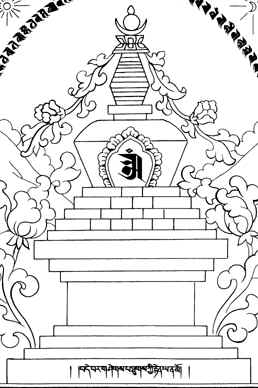
The Symbolism of the Stupa
Compiled by Mahasanti Karma Tharchin
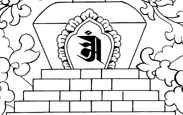
The complete stupa
Break down of stupa sections and their symbolic meaning:

- All accomplished

- Light of compassion
 -
-
Free from suffering

- Buddhahood

-Unsurpassed adornment

- Ten wisdoms

- Ten power and three mindfulness

- Buddha eye (place to draw the Buddha eyes)
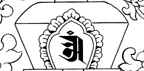
- Seven constituents of enlightenment

- Door

- Five powers

- Five roots

- Four bases of psychic power

- Four diligence

- Four mindfulness

- Four immeasurable mind

- Six paramitas
- Lion throne (place to draw the 8 lions supporting the stupa)

- Three refuge

- Ten precepts
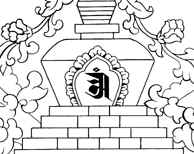
- 60 steps to Buddhahood
- 37 dharmas of enlightenment

- 13 stages (skt. bhumi)
By: Wong Ngai Ying
There are different levels of symbolism concerning the Buddhist stupa. First it is used to keep relics, statues or sacred texts of the Buddha or of other saints. Thus, it may be regarded as a palace or mandala of the Buddha or saint concerned. Thus, by erection of the stupa can restore the balance of the place, benefitting those who makes prostration to the stupa. Secondly, it can also represent the form-body of the Buddha, and it also contains a representation of a universe (the 3 realms: desire, form and formless). Actually, a mandala itself can be considered as a universe.
The stupa can also represent the path to enlightenment, which includes the ten percepts, triple refuge, six paramitas, four immeasurables, 37 dharmas of enlightenment (4 mindfulness, 4 diligence, 4 bases of psychic power, 5 roots, 5 powers, 7 constituents of enlightenment and 8 noble paths), and finally, to total accomplishment.
[ Index ]
Click here to send comments to the System Administrator.